Are Quokkas Friendly To Humans?
Quokkas look friendly and approach calmly, but they are wild animals protected by law. Here is what the rules actually say, and which tours fit them.
No, and yes, in a way that matters. Quokkas are wild marsupials, not tame animals, and every official rule on Rottnest Island treats them as such: observe from a safe distance, never touch, never feed, stay on the paths. What reads as friendliness is curiosity and habituation, and acting on it, even gently, can draw an on-the-spot fine and prosecution with fines up to A$10,000.
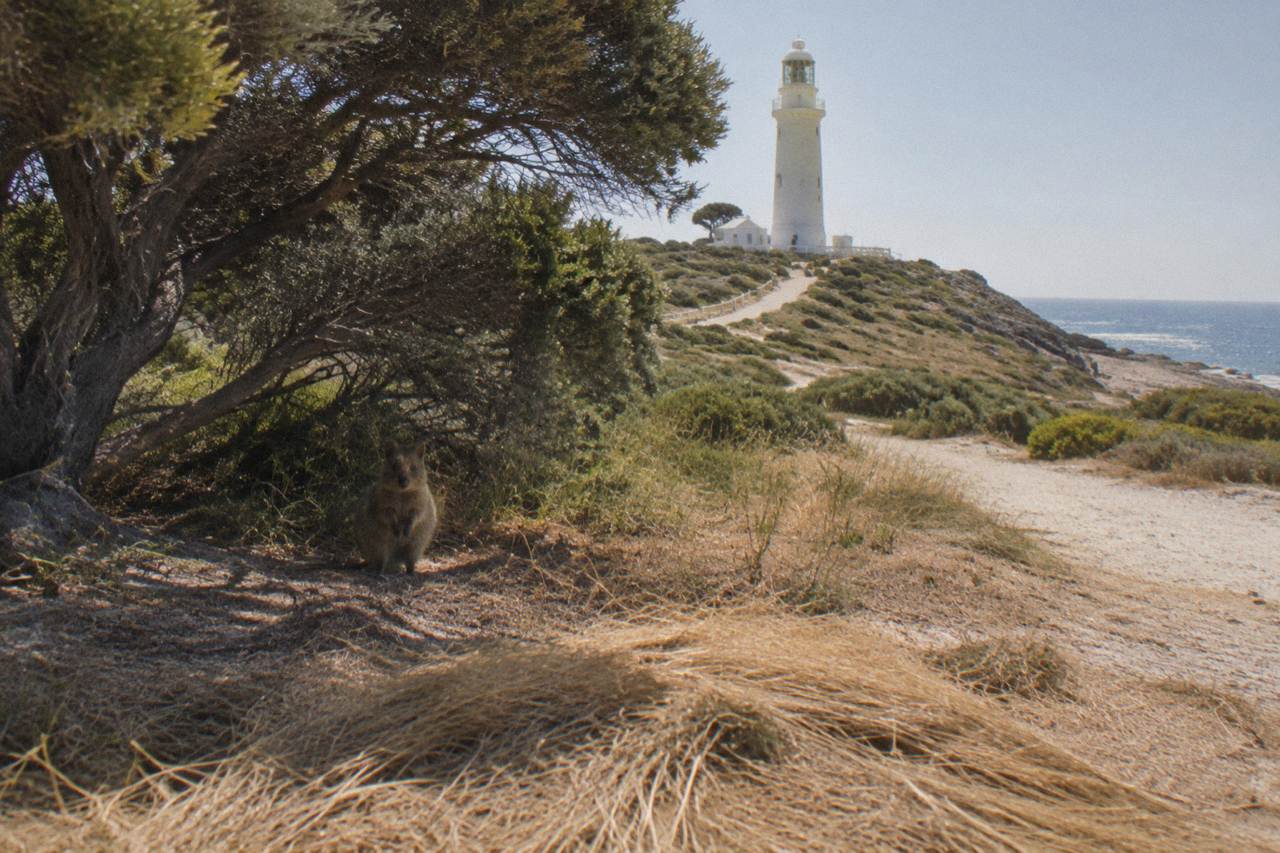
That distinction sounds like bureaucratic hair-splitting until you stand in Thomson Bay and a quokka strolls past your feet without a glance. The animal is not afraid of you. It has lived its whole life on a predator-free island where the tallest thing in the landscape is a lighthouse, and humans have never been a threat worth fleeing. So it does not run. It does not hide. Sometimes it will wander close, apparently unbothered, and a visitor could be forgiven for reading that as an invitation.
It is not an invitation. It is indifference, mixed with a hard-earned instinct that people sometimes drop food. The gap between how a quokka behaves and what a visitor may do is exactly the gap this article explains, because the rules are strict, well enforced, and easy to follow once you stop framing the animal as friendly.
The question also connects directly to how you should plan a day on the island. The tours that sell best here, the rickshaw and Segway products, the SeaLink ferry and bus tour, all shape the encounter around the rules rather than around the fantasy of a cuddle. More on those below. First, the animal itself.
Are Quokkas Friendly To Humans?
Quokkas are calm around humans, habituated rather than affectionate, and officially wild. The Rottnest Island rules are unambiguous: observe from a safe distance, do not touch, do not feed, stick to the paths. Deliberate interference can draw an on-the-spot fine under the Rottnest Island Regulations 1988 and prosecution with fines up to A$10,000. Curiosity is not consent.
Start with the biology, because it dissolves the question. A quokka is a small wallaby, roughly the size of a domestic cat, native to Western Australia and listed as Vulnerable under national environment law. The Rottnest subpopulation is the largest in the world, fluctuating between roughly 10,000 and 12,000 animals at its seasonal peak, in a landscape with no foxes, no cats, no dogs roaming free. The federal conservation assessment notes the mainland population is a fraction of that size, precisely because predators mostly are not.
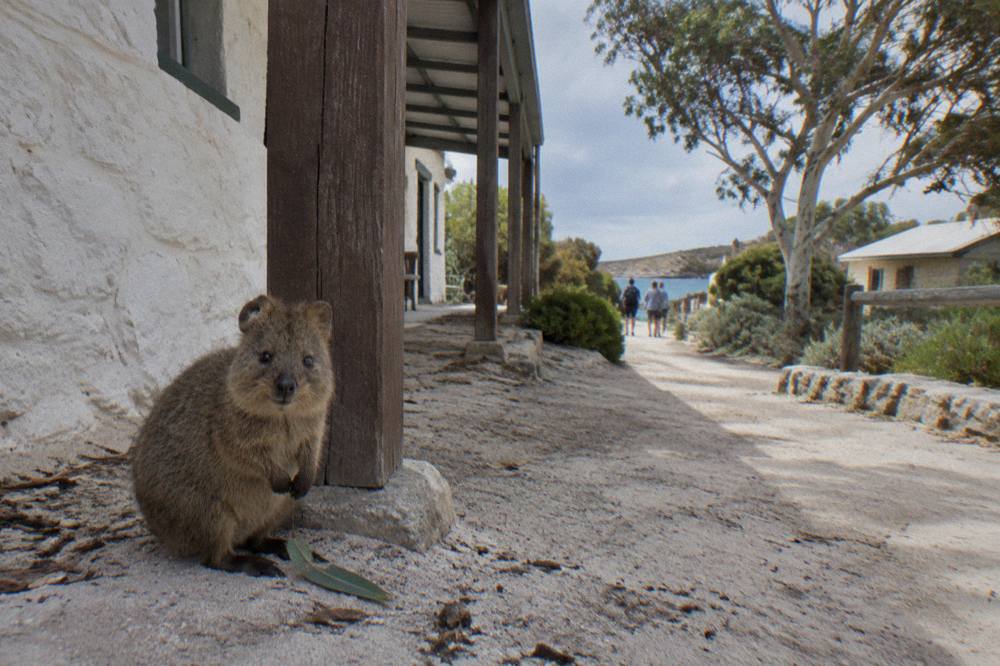
Put an animal with no evolutionary fear of predators on an island that receives hundreds of thousands of visitors a year, and you get habituation: individuals that have learned people are harmless and occasionally scatter crumbs. Habituation looks like friendliness. It functions like indifference. The quokka that wanders near your feet is not seeking your company; it is going about its foraging, and you simply are not on its list of things to fear.
That is the honest answer to the headline question. Friendly implies a relationship, a mutual warmth, a bond. There is none. There is a wild animal tolerating your presence because tolerating you costs it nothing, usually. When it costs the animal something, stress, disrupted feeding, a diet wrecked by human snacks, the law steps in, and the law does not care how gentle your intentions were.
Why Does The "Friendly" Framing Cause Problems?
Because it converts indifference into permission. Visitors who believe a quokka is friendly touch it, feed it, offer it water, or crowd it for a selfie, and every one of those actions is prohibited, with on-the-spot fines and prosecution carrying penalties up to A$10,000. The official guidance is to use camera zoom, step back slowly if one approaches, and never encourage close contact.
The Rottnest Island Authority's own wildlife protection guidance is blunt about this. Quokkas are wild, they are protected as part of a Class A Reserve, and the rules exist because well-meaning people harm them constantly. Feeding is the big one. Human food, even healthy-looking scraps, damages a quokka's digestion and teaches it to depend on handouts. Water is subtler and equally discouraged: quokkas get moisture from vegetation, and offering a drink trains animals to approach people, which ends badly for the animal first and the visitor second.
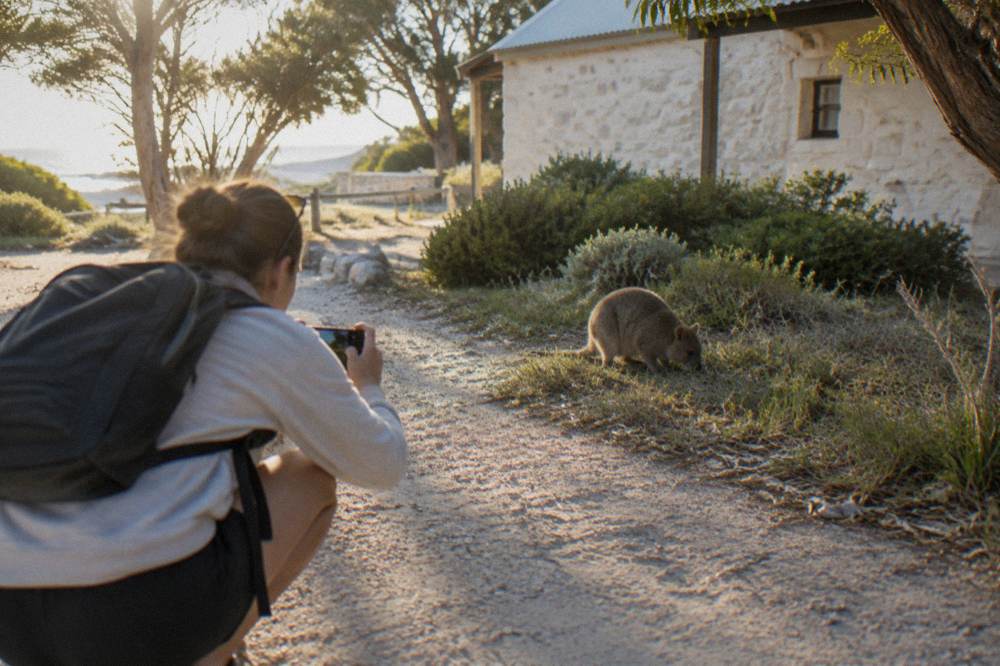
Then there is the selfie problem, the reason Rottnest became famous in the first place. A quokka's facial structure gives it what looks like a grin, photos went viral, and a small industry of quokka selfies followed. The official etiquette, published by the island's own channels, is workable and simple: use your camera's zoom, keep your distance, and if a quokka approaches you, step back slowly rather than leaning in. Never touch, never feed, never bait it into frame. A photo taken at zoom of a quokka going about its business breaks no rule and is genuinely better photography anyway.
The penalty structure explains how seriously the island takes this. Deliberate interference, which explicitly includes feeding, draws an on-the-spot fine under the Rottnest Island Regulations 1988 and can escalate to prosecution with fines up to A$10,000. Rangers patrol, and "it came to me first" is not a defence anyone should plan around. If you want the fuller story on the rules and why they are written the way they are, the companion piece on why touching is banned goes deeper.
Where Will You Actually See Quokkas, And When?
Family groups live right across the island, with concentrations near the Thomson Bay settlement where water and shade are reliable, and the best viewing is at dawn and dusk when this mainly nocturnal animal is most active. Spring adds joeys: pouch appearances from about August, first hops around September. No tour or spot guarantees a sighting, and none should promise one.
The settlement is where most visitors meet a quokka, and there is a reason. Quokkas cluster where resources do, and the lawns, gardens and shaded corners of Thomson Bay, plus the odd dropped crumb history has trained them to expect, make it the busiest real estate on the island. But the animal lives island-wide, and quieter bays and walking trails away from the crowds often give calmer, more natural encounters. The official advice is to look in shade during the middle of the day and plan serious viewing for the first and last hours of daylight.
Season changes what you see. Quokkas breed in late summer, joeys emerge in the pouch from about August, and by September the young ones are taking their first wobbly hops. Spring visitors therefore get both the adults and the next generation, and the timing lines up neatly with the start of the warm-water season. The piece on the best times of day and year covers the seasonal pattern in detail.
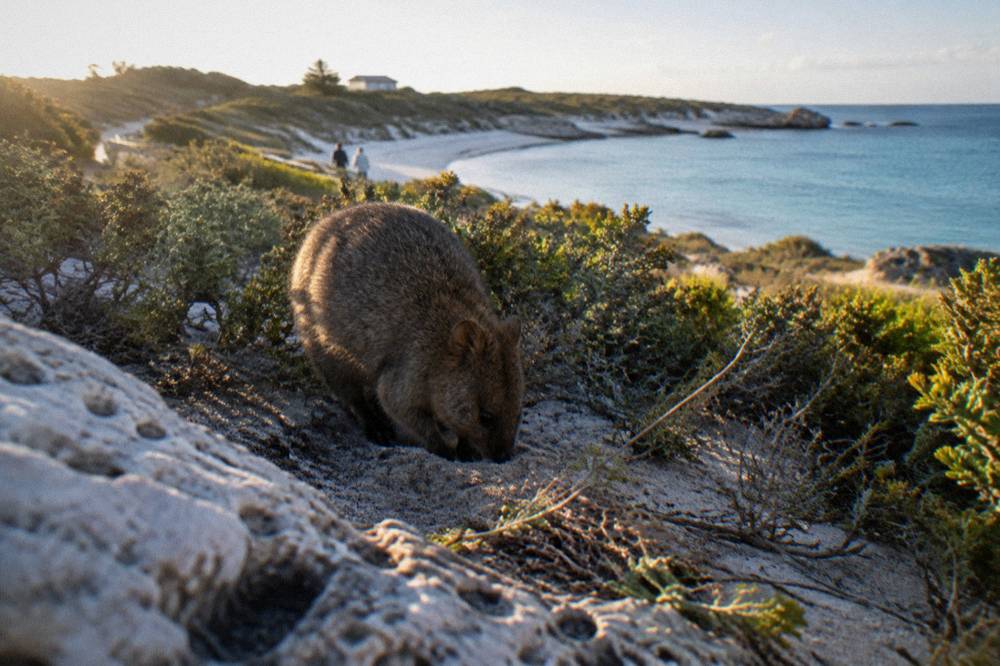
Honesty check, because the internet will not give you one: no operator on this roster guarantees a quokka sighting, and any that did would be selling something the animal has not agreed to. What the good tours do is put you on the island at the right hours, with a guide who knows where family groups feed, and move you through at a pace that lets you watch rather than chase. That is a better product than a promise.
Which Tours Work Best With The Rules?
The ones built around observing rather than approaching: the private rickshaw tour from Thomson Bay, the Segway tours of the settlement and fortress roads, and the bus loop that reaches quieter habitat without you having to plan a route. All keep you at distance, all are guided, and the rickshaw and Segway products cap group size, which keeps encounters calm.
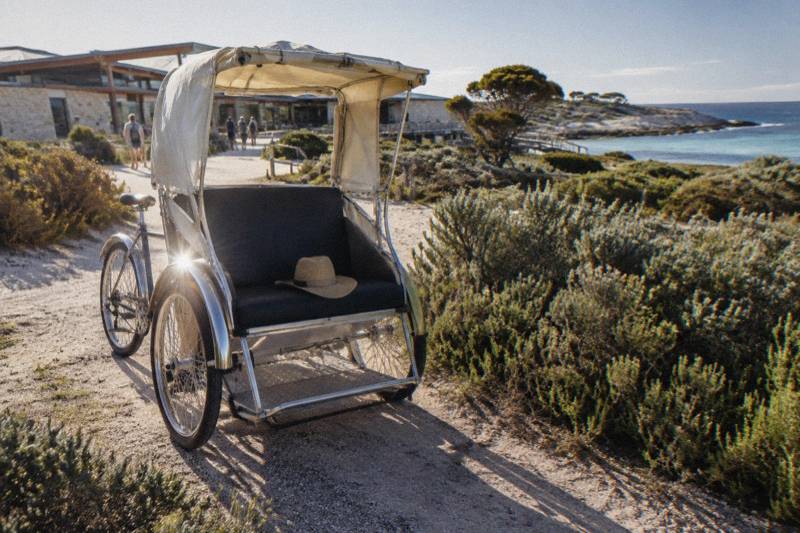
The Rottnest Island Tours roster has three formats that suit quokka watching, each for a different traveller. The rickshaw is the most direct fit: a private tour for up to three adults or a family of four, departing Frankie's on Rotto in Thomson Bay, rated 5 from 15 reviews and priced from A$145 per person. A guide pedals, you ride, and because it is private, the route and pace flex around what the group wants to linger on. The format also enforces distance by design: you stay seated, the guide handles the approach, and there is no moment where a visitor is crouched at ground level reaching toward an animal.
The Segway option covers more ground. The one-hour Settlement Segway tour, from A$98 per person with a 4.7 rating from 63 reviews, loops the Thomson Bay area where quokkas are most commonly seen. The 1.5-hour Fortress Adventure version, from A$139 and rated 4.8 from 117 reviews, heads out toward the island's military heritage roads, takes a maximum of 10 per group, and passes through quieter habitat where animals behave more naturally than on the busy settlement lawns.
For visitors who want the simplest possible day, the SeaLink ferry and bus tour bundles the crossing with an island coach loop, from A$149 per person, rated 4.6 from 1,515 reviews, with the island admission fee collected inside the fare. It is the format for anyone who would rather not plan a single thing between the mainland and the last ferry home.
The comparison below puts the three side by side.
| Tour | Format | Price from | Rating | Duration | Why it suits quokka watching |
|---|---|---|---|---|---|
| Private rickshaw tour | Private, guide-pedalled, up to 3 adults or family of 4 | A$145 pp | 5 from 15 reviews | 1.5 hours | Seated viewing, private pace, Thomson Bay start |
| 1-Hour Settlement Segway | Guided small-group Segway | A$98 pp | 4.7 from 63 reviews | 1 hour | Loops the settlement where sightings are most common |
| Fortress Adventure Segway | Guided Segway, max 10 per group | A$139 pp | 4.8 from 117 reviews | 1.5 hours | Quieter roads, less disturbed animals |
| SeaLink ferry and bus tour | Ferry plus island coach loop | A$149 pp | 4.6 from 1,515 reviews | 7 hours to full day | Reaches habitat across the island without planning |
What Should You Do If A Quokka Approaches You?
Step back slowly, keep your hands to yourself, and let the animal continue on its way. Do not crouch, do not reach out, do not offer food or water, and do not block its path while framing a photo. The official guidance is exactly this: use camera zoom for distance, step back if approached, never encourage close contact.
The scenario happens daily, usually near the settlement bakeries and lawns, and how a visitor handles it is the difference between a good story and a fine. A quokka that ambles toward you is almost certainly just passing through, not socialising: you are between it and the shade it wants, or it has learned that the spot where humans stand sometimes yields food. Back away, give it the space to pass, and it will. The animal decides the distance; your only job is not to reduce it.
Photography deserves its own sentence or two, because the quokka selfie is the behaviour the rules were largely written to manage. Zoom exists. Every phone made in the last several years has a lens good enough to fill a frame with a quokka from several metres, and the resulting photo, an animal behaving naturally in its own habitat, beats a close-up of a stressed marsupial cornered by a stranger. Frame wide, let the animal move through the shot, and never position a quokka between you and your exit.
Group behaviour matters as much as individual behaviour. A crowd around a single quokka, even a respectful crowd, cuts off its escape routes and stresses it. If you come across a gathering, take your look from the outside of it and move on. And if you see someone feeding or touching an animal, the right response is the ranger line, (+61 8) 9372 9788, rather than a confrontation. The island's protect-our-wildlife page states the rules plainly, and they apply to everyone equally.
Are Quokkas Dangerous, Or Just Misunderstood?
Neither, really. They are not aggressive and pose no meaningful threat to a person who follows the rules, but they are wild animals with wild needs, and the law protects them from people, not the other way around. No verified incident statistics exist for this island, and none are needed: the safe distance rule removes the question entirely.
It is worth killing a couple of internet myths while we are here. Quokkas do not throw their young at predators; that claim is a garbled misreading of behaviour in a different macropod species under extreme stress. Rottnest quokkas are not diseased menaces, nor are they cuddly toys. They are herbivorous, mainly nocturnal marsupials that can climb trees, that sometimes stand on their hind legs to look around, and that have adapted to human presence without ever depending on it, provided visitors keep their hands and snacks to themselves.
The genuine risks in a quokka encounter run one way. A fed animal becomes a dependent animal. A touched animal becomes a stressed one. A cornered animal, like any wild creature, may defend itself, which is why the rules forbid the situations in which that could happen rather than warning you what happens next. The safe-distance rule is not caution, it is the whole framework.
Misunderstanding also cuts the other way. Quokkas are sometimes framed as the island's mascots, a marketing asset with a smile, which flattens them into props. The reality is more interesting: a Vulnerable species whose largest surviving population lives on a Class A Reserve, managed by an authority that balances tourism with conservation, and monitored in annual reporting that has rated quokka health positively in recent years. Treating them as wild is what keeps that true. The wider guide to quokka tours and etiquette pulls all of this together for trip planning.
How Do You Plan A Quokka-Respectful Day Trip?
Arrive early, base yourself near Thomson Bay for the dawn and dusk activity windows, book a guided format rather than freelancing an approach, and follow the touch, feed and path rules without exception. A ferry-and-tour package from A$98 to A$149 per person covers everything except lunch, and most listings on the roster allow free cancellation.
The practical pattern works like this. Take an early ferry, which puts you on the island inside the morning activity window; crossings run about 25 minutes from Fremantle, 45 from Hillarys, and up to 90 from Barrack Street Jetty in Perth. Spend the first hour walking the settlement and Thomson Bay lawns at a distance, camera at zoom. Midday, when quokkas retreat to shade, is the slot for your booked activity, a Segway loop, the rickshaw, or the bus tour out to the lighthouse and West End. Return to the settlement for the late-afternoon window before the ferry home.
Budget-wise, the building blocks are straightforward, and the table below shows how the pieces stack for a quokka-focused day.
| Component | From (per person) | Notes |
|---|---|---|
| Return ferry and admission from Fremantle | A$90 | SeaLink same-day return, admission collected in the fare |
| 1-Hour Settlement Segway tour | A$98 | Guided, settlement loop, free cancellation |
| Private rickshaw tour | A$145 | Private, up to 3 adults or family of 4 |
| SeaLink ferry and bus tour | A$149 | Ferry, coach loop and admission bundled |
| Fortress Adventure Segway | A$139 | 1.5 hours, max 10 per group |
Two reminders that are easy to lose in the excitement. The island admission fee, A$21.50 adult single day, is collected inside ferry fares, so you do not pay it separately. And helmets are legally required on any bike, which matters if your quokka day includes cycling rather than a guided tour. Peak season books out early for both ferries and island activities, so reserve ahead.
The last word on friendly: reframe it. A quokka is not friendly to you, it is unafraid of you, and that unafraid-ness is a fragile inheritance of a life without predators that your behaviour either protects or erodes. Watch long enough at a proper distance and you will see everything the selfies promise and more: a mother with a joey, a stand-off between two males, an animal climbing a low tree to browse. None of it requires your touch. All of it requires your restraint.
Common Questions About Quokkas And Humans
Are Quokkas Friendly To Humans?
Quokkas are calm and habituated around people, but they are wild animals, not friendly ones in any meaningful sense. The rules on Rottnest Island are clear: observe from a safe distance, never touch, never feed, and step back slowly if one approaches you.
Can I touch or feed a quokka?
No. Touching and feeding quokkas is prohibited, and deliberate interference can draw an on-the-spot fine under the Rottnest Island Regulations 1988 and potential prosecution with fines up to A$10,000.
What should I do if a quokka comes up to me?
Step back slowly and let it pass. Do not crouch, reach out, offer food or water, or block its path. Use your camera's zoom for photos rather than moving closer.
When is the best time to see quokkas?
Quakkas are mainly nocturnal and most active early morning and late afternoon. Joeys appear in the pouch from about August and take their first hops around September, making spring a rewarding season.
Do any tours guarantee a quokka sighting?
No. Quokkas are wild and no operator guarantees an encounter. Guided formats such as the private rickshaw tour, the Segway tours and the island bus tour improve your odds by timing and local knowledge, not promises.
Where do quokkas live besides Rottnest?
Small mainland populations exist in the forests of south-west Western Australia, estimated at a few thousand animals, and on some islands. Rottnest supports the world's largest population, fluctuating to roughly 10,000 to 12,000 at seasonal peak.